The CBR press in our lab operates a piston at a steady 1.27 mm per minute, plunging into a compacted specimen submerged in water for four days. That four-day soak is what matters most in Waterloo. The silty clay till underlying much of the city holds moisture through spring thaw and fall rains, and a subgrade that tests fine dry can turn to mush once the water table rises near the Grand River watershed. Contractors bringing in samples from projects along King Street or near the university district need a soaked CBR value that reflects real post-construction conditions. The test itself is straightforward mechanics: we compact the soil at optimum moisture, apply a surcharge ring to simulate pavement weight, and measure penetration resistance at 0.1-inch increments. But interpreting those numbers for a Waterloo winter, with freeze-thaw cycling down to 1.2 meters depth, requires local experience. When roadway cores come in from projects near the Conestoga Parkway, we often pair the CBR with a grain size analysis to confirm fines content before locking in the design modulus. The soaked CBR typically falls between 3% and 8% for the native Port Stanley Till, which tells you right away whether lime stabilization or a thicker granular base is needed.
A soaked CBR of 3% in Waterloo till means you're placing pavement on a material that loses two-thirds of its dry strength after saturation.
Service characteristics in Waterloo Ontario
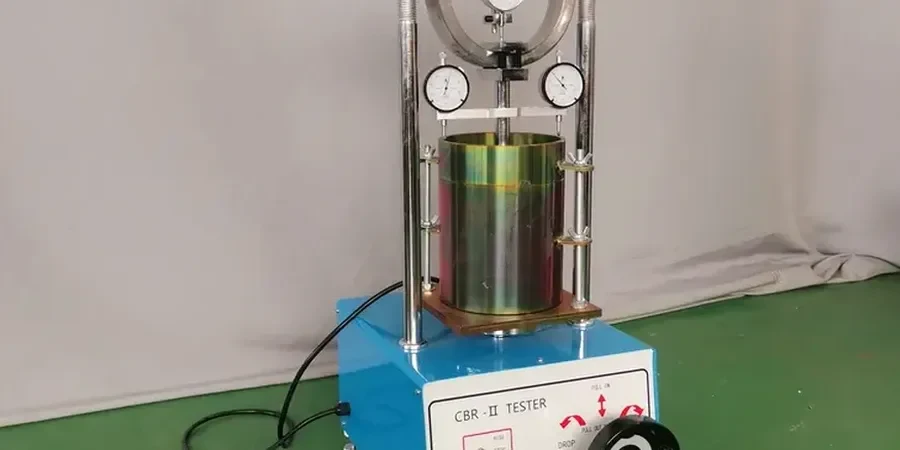
Demonstration video
Risks and considerations in Waterloo Ontario
The Port Stanley Till that underlies most of Waterloo contains 15% to 40% clay-size particles with moderate plasticity, making it highly susceptible to moisture-induced strength loss. A CBR test run without the four-day soak can overestimate subgrade support by 50% or more. We've seen pavement sections on University Avenue fail within three years because the design assumed a CBR of 8% from a quick unsoaked test, when the actual soaked value was under 4%. The risk compounds in low-lying areas near the Grand River and its tributaries, where the groundwater table sits within 1.5 meters of the surface seasonally. Under those conditions, the subgrade never truly drains, and the CBR you get in the lab after soaking is what the soil will deliver for the pavement's entire service life. Ontario's freeze-thaw adds another layer: ice lenses form in the silt matrix over winter, and when they melt in April the subgrade temporarily drops to its weakest state. A CBR below 3% soaked means the pavement structure needs a full granular separation layer plus subdrains, or the City of Waterloo will flag it during permit review. Skipping the soaked test isn't a shortcut; it's a liability that transfers straight to the contractor's warranty period.
Our services
Our Waterloo laboratory runs CBR testing as part of a broader pavement materials program. The four services below cover the full workflow from subgrade sampling to structural design input.
Soaked CBR Determination
Four-day submerged test per ASTM D1883 on compacted subgrade specimens. Includes swell measurement, moisture content before and after soak, and corrected CBR at both 0.1-inch and 0.2-inch penetration.
Compaction Curve with CBR
We establish the moisture-density relationship first, then compact three CBR specimens at optimum moisture to confirm repeatability. Reported with the full Proctor curve and CBR at 95% and 100% density.
Subgrade Stabilization Verification
When lime or cement treatment is specified, we run CBR on treated specimens after a seven-day cure and four-day soak. Tests whether the stabilized mix meets the 15% to 20% CBR target under OPSS 1010.
Granular Base CBR
Testing of Granular A and Granular B materials at modified Proctor density. Used to verify that imported subbase meets the CBR threshold specified in the pavement structural design.
Frequently asked questions
What does a laboratory CBR test cost in Waterloo?
A standard soaked CBR test on a single specimen runs between CA$160 and CA$270, depending on whether we need to establish the compaction curve first or if you provide the optimum moisture and maximum dry density. A full program with three-point compaction plus three CBR specimens typically falls in the CA$400 to CA$550 range. Rush turnaround within 48 hours adds a small surcharge.
Why does the CBR specimen need to soak for four days?
The four-day soak simulates the worst-case saturated condition the subgrade will experience over the pavement's life. In Waterloo, the silty clay till can take on significant moisture from spring snowmelt and seasonal high groundwater. A test run without soaking can show a CBR of 10% or more, while the soaked value drops to 3% or 4%. Designing with the unsoaked number leads to underbuilt pavement that cracks and ruts within a few seasons.
How many CBR tests do I need for a residential subdivision in Waterloo?
The City of Waterloo generally requires one CBR test per distinct soil unit encountered, with a minimum of three tests per subdivision. If the site has uniform Port Stanley Till across the footprint, three specimens from different borehole depths may suffice. If you hit pockets of organic silt near a creek or varied fill in redeveloped areas, each material needs its own CBR determination. We coordinate with the geotechnical drilling program to pull undisturbed samples at the right intervals.