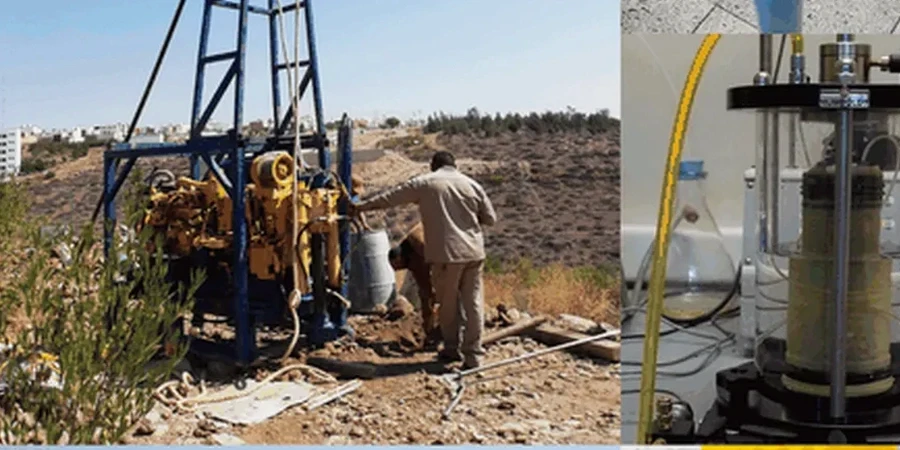
A truck-mounted drill rig advances through stiff glacial till near the Conestoga Parkway, extracting thin-walled Shelby tube samples from 12 meters below grade. The cores come up dense and overconsolidated, typical of the Port Stanley Till that blankets much of Waterloo. In the lab, technicians trim specimens on a lathe for consolidated-undrained triaxial tests while another set measures natural moisture content on silty clay from the upper weathered zone. A complete soil mechanics study in Waterloo Ontario has to reconcile the high silt content of the Tavistock and Maryhill formations with the groundwater regime of the Waterloo Moraine, because the same till that stands almost vertically during excavation can soften rapidly when drainage is poor. The work feeds directly into bearing capacity calculations and foundation design parameters that the National Building Code of Canada requires for any structure exceeding 600 square meters.
Glacial till in Waterloo is overconsolidated by ice loading, meaning its undrained shear strength often exceeds 150 kPa, but remolded strength drops to half that value when water invades the silt fraction.
Service characteristics in Waterloo Ontario
Risks and considerations in Waterloo Ontario
Contrast between the high-ground neighborhoods around Westmount and the low-lying industrial zones near Bridgeport illustrates the risk clearly. On the moraine uplands, Port Stanley Till extends 15 meters or more as a stiff, overconsolidated blanket, and a soil mechanics study in Waterloo Ontario typically returns bearing capacities above 250 kPa for strip footings placed below the frost line. Downslope toward the Grand River, the stratigraphy changes within a few hundred meters: ablation till and outwash sand alternate with lenses of lacustrine silt that are normally consolidated and prone to sudden strength loss under cyclic loading. A foundation designed for the upland conditions cannot be copied to the valley margin without a new set of consolidation and shear data. The same contrast plays out when comparing the Dundee Formation bedrock near the university with the deep buried valleys mapped by the Ontario Geological Survey, where over 30 meters of compressible fine-grained sediment require a completely different settlement analysis.
Our services
The soil mechanics program we deliver in Waterloo Region moves from field sampling to lab characterization and final geotechnical recommendations in a sequence designed to eliminate guesswork from foundation design.
Triaxial and Consolidation Testing Suite
Consolidated-undrained triaxial with pore pressure measurement on Shelby tube specimens, plus incremental oedometer consolidation to produce the compression index, recompression index, and coefficient of consolidation for each compressible unit encountered in the borehole log.
Index Property and Strength Profiling
Complete Atterberg limits, natural moisture content, and grain-size distribution for every distinct stratum. Combined with pocket penetrometer and torvane readings taken in the field, the index data create a continuous strength profile that flags softened zones before the lab results arrive.
Foundation Parameter Report
A sealed document providing allowable bearing pressure, anticipated total and differential settlement, spring constants for structural modeling, and recommendations for sub-drainage where groundwater perched on the till surface could affect long-term performance of the slab.
Frequently asked questions
What is the typical cost range for a soil mechanics study on a residential lot in Waterloo?
For a single-family residential parcel requiring one to two boreholes with triaxial and consolidation testing, the study typically falls between CA$4,000 and CA$8,180. The spread depends on drilled depth, number of Shelby tube samples recovered, and whether groundwater monitoring wells are needed. Sites near the Grand River floodplain or with suspected buried valleys usually fall toward the higher end because additional lab tests are required to fully characterize compressible silts.
How does the Waterloo Moraine geology affect the lab testing program?
The moraine deposits include a mix of Port Stanley Till, Maryhill Till, and interbedded glaciolacustrine silts that can change within a single borehole. The testing program must account for this variability by running Atterberg limits and triaxial shear on specimens from each distinct unit, not just a composite sample. The high silt content in the Maryhill Till means drained strength parameters often govern foundation design, which is why we run consolidated-drained or CIU with pore pressure measurement rather than relying solely on unconfined compression.
How long does it take to receive the final soil mechanics report?
Drilling and sampling are typically completed in one to two days. Consolidated-undrained triaxial tests require about seven to ten working days because specimens must be saturated, consolidated, and sheared at a slow strain rate. Consolidation tests run five to seven days per specimen depending on the load increment schedule. The sealed report, including parameter tables and foundation recommendations, is delivered three to four weeks after field work concludes, assuming standard lab queue times.